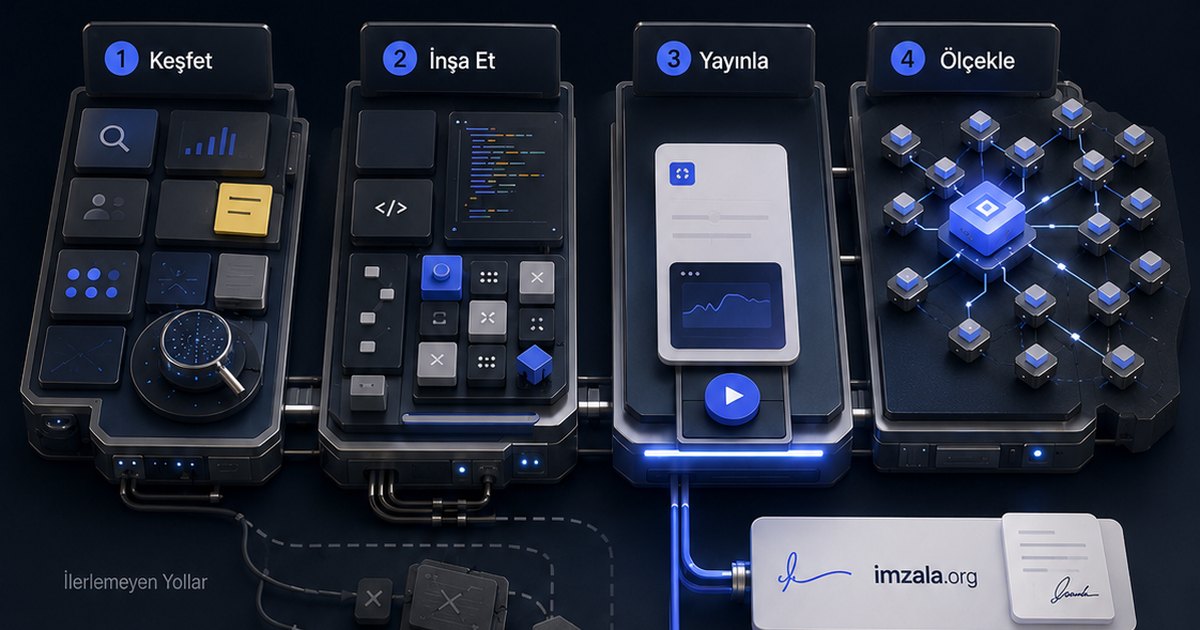
A venture studio is an organization that systematically generates, validates and builds product ideas in-house until they become companies, rather than focusing on a single venture at a time. Codeck describes itself as a lean SaaS venture studio. In this post we explain what the model is, how it differs from similar structures, and how we apply it in practice. The goal is not merely to talk about ourselves; it is to draw an honest map, with the parts that work and the parts that do not, for founders and organizations evaluating this model.
What is a venture studio
In its classic definition, a venture studio produces new company ideas within its own walls, turns the most promising ones into products with its own team, and spins the ones that grow out into independent companies. It is also known as a startup studio, company builder or venture builder. Well-known examples worldwide include Rocket Internet, Idealab and eFounders.
The model is best understood side by side with the structures it is confused with.
How it differs from an agency
An agency builds its client’s idea with its client’s money; its responsibility ends at delivery. A studio builds its own idea with its own resources and is a long-term partner in the product’s fate. That difference fundamentally changes how a team behaves: on a project you hand over and leave, technical debt is someone else’s problem; on a product you will operate for years, it is directly your own bill.
How it differs from a venture fund (VC)
A fund puts capital into companies started by outside founders and stays out of management. A studio is the owner of the idea, its first team and usually its first engineer. A fund bets on a few successes out of a hundred portfolio companies; a studio runs far fewer ventures far more closely.
How it differs from incubators and accelerators
Incubators and accelerators offer office space, mentorship and a program to founders who come from outside. A studio does not wait for an outside founder; generating, validating and building ideas is the job itself. A studio is not a program but a continuously running product factory.
What “lean” and “SaaS” change
The venture studio umbrella is broad; we narrow our own model with two words.
Lean means ideas are tested with the smallest verifiable versions, not with big budgets. Eliminating a weak idea early and cheaply is the model’s most critical discipline. Instead of building a flawless product for months only to meet the market’s indifference, we ship a working core within weeks, test it with real users, and decide to continue or stop based on data.
SaaS defines the focus area: not one-off deliveries, but software products that live on subscriptions and are operated continuously. SaaS has a natural affinity with the studio model, because the same infrastructure, the same payment systems and the same operational discipline serve every new product again and again. The foundation you build for the first product lowers the cost of the second.
How the model works in practice
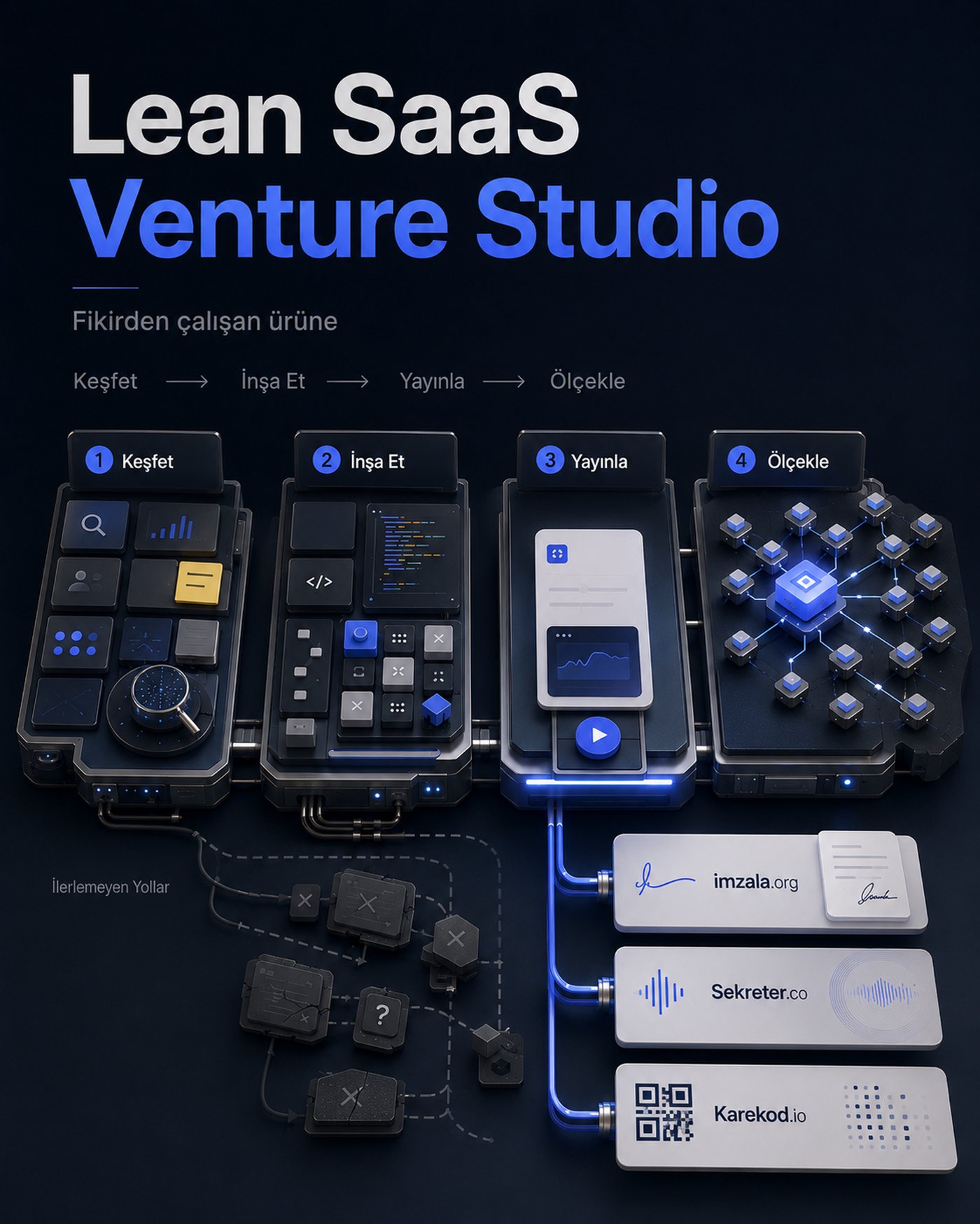
In our implementation, every idea passes through a four-stage pipeline. It is exactly the cycle we describe as the “studio model” on our site.
1. Discover
Idea, market and validation. Whether the problem really exists, who would pay to solve it and how large the market is are questioned at this stage. Most ideas do not pass, and that is the model succeeding: the cheapest failure is the one that happens before any code is written.
2. Build
Lean MVP engineering. Small team, short cycles, production quality from day one. A “lean” MVP does not mean a careless one; we give up the long feature list, never the engineering standard.
3. Launch
The product meets the market: pricing, go-to-market, onboarding. A truth often forgotten in software: a product that does not sell is not finished. This stage demands commercial discipline as much as engineering.
4. Scale
A validated product goes into 24/7 operation on our own infrastructure, built to grow without a rewrite. This is where the product becomes a living service and revenue and operations mature.
Why the model works
The studio model’s strength comes from accumulation compounding like interest.
Shared infrastructure. Building blocks every product needs, such as authentication, payments, email, monitoring and backups, are built once, and every new product is born on top of them. The first version of a new idea finds ready the foundation a from-scratch startup would spend weeks assembling.
Repeated learning. Every product’s pricing experiments, onboarding flow and marketing channels leave data for the next one. A single-venture team learns these lessons once; a studio applies the same lesson across the whole portfolio.
Team continuity. In a classic startup, when the company closes the team scatters and the accumulated knowledge is lost. In a studio, a failed product shuts down but the team, the infrastructure and the lessons carry into the next idea.
Honest limits: what the model does not solve
This model is easy to market and hard to execute, and some risks should be stated plainly.
Focus risk. Many products at once means divided attention. The antidote is strict stage gates: an idea that cannot pass discovery does not get to occupy the team’s agenda.
Not every idea reaches the market. Our own portfolio also includes products that were completed technically but never launched commercially. In such cases what was learned about the architecture and the market carries into later products; that is exactly how the model works, but it is a consolation prize, not a success. The studio model does not eliminate failure; it lowers its cost and keeps its lesson.
It demands patient capital. SaaS revenue accumulates slowly. To sustain the model, a studio needs a steady revenue engine; for us, that engine is the enterprise engineering side described below.
How Codeck applies the model
Today we operate three live SaaS products: imzala.org, an electronic signature and contract platform; Sekreter.co, an AI assistant answering phone calls in more than 50 languages; and Karekod.io, a dynamic QR management platform. All three went through the four-stage pipeline above, and all three run on our own Kubernetes infrastructure.
What distinguishes our implementation is that the studio works in symbiosis with our enterprise engineering side. We deliver custom software, cloud and AI services to enterprises, and this side is where the studio’s scale muscle gets trained. The Adekstra HbbTV advertising and analytics platform, handling millions of requests per minute; the Hamidiye ordering infrastructure, where thousands of daily orders flow error-free and against the clock between dealers, management, production and customers; and UXAudit.Now, the AI-assisted interface audit product we built for a client, are some of the work on that side. The engineering muscle built in that work feeds our own products, and the architectural patterns proven in our products carry into client projects. For our clients the concrete meaning is this: your project is handled by a team that knows what operating a product means from its own bills.
If you are curious how the company evolved into this model, we tell the story on our About page: a journey that started as a software development office in 2019 and, after dozens of client products, turned into a studio investing in its own products in 2021.
What it means for founders and enterprises
For a founder with an unvalidated product idea, the studio model offers a third path between “hiring a dev team” and “taking on a co-founder”: having the idea go through a lean validation pipeline with a team that has built and operated products of its own. For enterprises, the same discipline applies to internal ventures and new digital product initiatives; our MVP pipeline works the same way for in-house ideas.
If you would like to discuss your idea or project, get in touch; in a discovery call we will evaluate your idea against the framework in this post. If it is an idea you should walk away from, we will say that plainly too; that is the first promise of the lean model.